
Achilles Injuries
Achilles tendon injuries can occur in dogs and cats. It is a condition that requires treatment and can be managed effectively.
This article will explore these injuries and help you understand the causes, diagnosis, and treatment options. Have a pet with a suspected Achilles injury? Schedule a consultation with one our orthopedic surgeons today to discuss the latest advances in surgical repair!
Anatomy
The achilles tendon, also known as the common calcaneal tendon, is a combined tendon from multiple muscles of the pelvic limb: the superficial digital flexor, the gastrocnemius, the gracilis, the semitendinosus, and the biceps femoris. It connects these muscles to the calcaneus bone in an animal’s tarsus (ankle), allowing ankle extension and digit flexion.
Injury
This tendon can be injured in a number of ways, but the most common injury groups are traumatic and chronic/degenerative.
Traumatic
The tendon can rupture when impacted by an acutely traumatic event. Potential sources of trauma include laceration, bite wounds, and high levels of activity (usually sporting or working dogs).
Chronic
This form of injury, more common in older large breed dogs, is the result of chronic degenerative changes. The changes can be initiated by low-level chronic tearing, hypothyroidism, Cushing’s disease, or for an unknown reason.
Severity of injury can range from mild stretching to complete transection of the tendon or avulsion of the tendon from its attachment on the bone.
Diagnosis
Physical Examination
Complete rupture can result in the animal walking with a dropped hock, or an ankle much closer to the ground than normal. Sometimes there is a palpable defect in the tendon if the surrounding tendon sheath is also torn.
Partial tears will often result in the superficial digit flexor portion of the tendon remaining intact. This configuration results in a mildly to moderately dropped hock along with knuckling of the digits. In both cases, there is typically swelling noted around the point of the hock.
Imaging
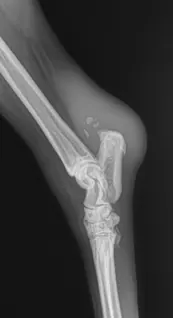
Radiographs, or x-rays, are often the first step in imaging potential achilles injuries. While radiographs cannot visualize the tendon directly, they can detect swelling surrounding the tendon, bone avulsion fragments, and mineralization of the tendon in chronic cases. Additionally, they can rule out other potential causes of damage to the area like fractures. Here you can see swelling around the calcaneus with mineralization of the tendon in a chronic injury of an older Labrador Retriever.
To determine the degree of injury, MRI or ultrasound can be used to further image the tendon. Ultrasound is typically used as it is more readily available, often only requires mild sedation, and provides acceptable visualization in the majority of injuries.
Treatment
Medical Management
In mild cases, medical management can be attempted which consists of immobilizing the joint, rest, and pain medications. Immobilization can be performed via splinted bandages or custom orthosis braces. This process typically takes 6-12 weeks.
Surgery
The basis of surgery involves reattaching healthy ends of tendon back to each other via suture, mesh, or a graft. At Metropolitan, we utilize the latest advances in achilles repair, including adapting human-grade implants for veterinary use. Following surgical apposition, the tendon is immobilized using a splinted bandage, custom orthosis, or surgically via an external fixator or internal screw placement. The achilles tendon often does not have a robust healing response, and immobilization allows the tendon ends to regain strength faster and heal more appropriately. These options will be discussed with your pet’s surgeon based on the individual case.
In severe cases where the tendon cannot be repaired or where the tendon has ruptured repeatedly, a tarsal arthrodesis or ankle fusion, may be recommended. This procedure removes the source of discomfort but does not allow for ankle motion.
Recovery
Your pet will require a period of rest and recovery for 8-12 weeks in most cases. The surgical incisions typically heal over a 2-week period. The tendon will continue to heal and reorganize over a 12-month period. Physical therapy may be recommended to continue strengthening the area. Platelet Rich Plasma (PRP) and shockwave therapy can be considered as adjunct treatments.
Outcome
Over 70% of dogs & cats have a good to excellent return to function. A sub-set of animals will re-rupture their tendons over the long-term, particularly if a degenerative process is impacting the tendon.
Conclusion
Achilles tendon injuries are encountered with regularity in both dogs and cats. Signs may be subtle at first or may occur suddenly. While difficult to heal, achilles ruptures have multiple treatment options. Schedule a consultation with one our orthopedic surgeons today to discuss your pet’s lameness and treatment!