
When pets are critically ill or recovering from a serious emergency, they need more than “routine” hospital care — they need continuous monitoring, rapid intervention, and a team trained to manage complex, fast-changing conditions. MVA and Hickory’s Critical Care teams work alongside our Emergency doctors and in-house specialists to provide round-the-clock ICU support for hospitalized patients.

What Is Veterinary Critical Care?
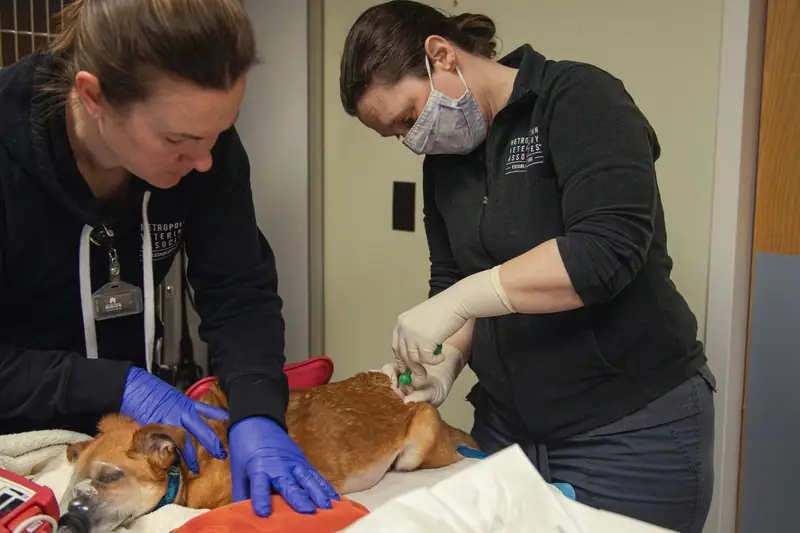
Critical care focuses on the treatment of patients who need intensive monitoring and advanced supportive care. These are pets whose condition could change quickly, and who benefit from frequent reassessments, timely adjustments to treatment, and 24/7 nursing oversight in an Intensive Care Unit (ICU). Our ICU is staffed by Criticalists (board-certified in Emergency & Critical Care) as well as dedicated ICU nurses, enabling continuous monitoring and treatment for critically ill pets.
When Does Your Dog or Cat Need Critical Care?
Your family veterinarian provides outstanding comprehensive care. However, some medical emergencies and complex illnesses require intensive hospitalization and close monitoring. Critical care may be recommended for pets experiencing:
- Severe trauma (such as being hit by a car or significant falls)
- Breathing distress or oxygen-dependent conditions
- Life-threatening infections (including sepsis)
- Serious dehydration or shock
- Uncontrolled vomiting/diarrhea with weakness or collapse
- Toxicities and severe metabolic emergencies
- Post-operative complications or high-risk surgical recovery
- Any condition requiring frequent reassessment and around-the-clock supportive care
Our Approach
Our Emergency and Critical Care teams collaborate with your family veterinarian and MVA and Hickory’s specialty services to coordinate diagnostics, treatment, and next steps. If a patient needs specialty consultation (for example, surgery, internal medicine, cardiology, neurology, or oncology), we can coordinate that care within the hospital to support the best possible outcome.
What to Expect
Hospitalization in the ICU often follows an ER evaluation, or a referral from your primary veterinarian.
We evaluate your pet’s immediate needs and begin urgent treatment and monitoring.
Once your pet is stable, we’ll review what we know so far, what we’re concerned about, and the recommended plan (including diagnostics, treatments, and estimated costs).
ICU patients are monitored closely, and treatment plans are adjusted as your pet responds. Our ICU is staffed around the clock to provide continuous care.
When your pet is ready to go home (or transfer to another service), we’ll provide a discharge plan and share records with your family veterinarian to support continuity of care.
If you believe your pet is experiencing an emergency, please call ahead before coming so our team can help you with immediate next steps and prepare for your pet’s arrival.